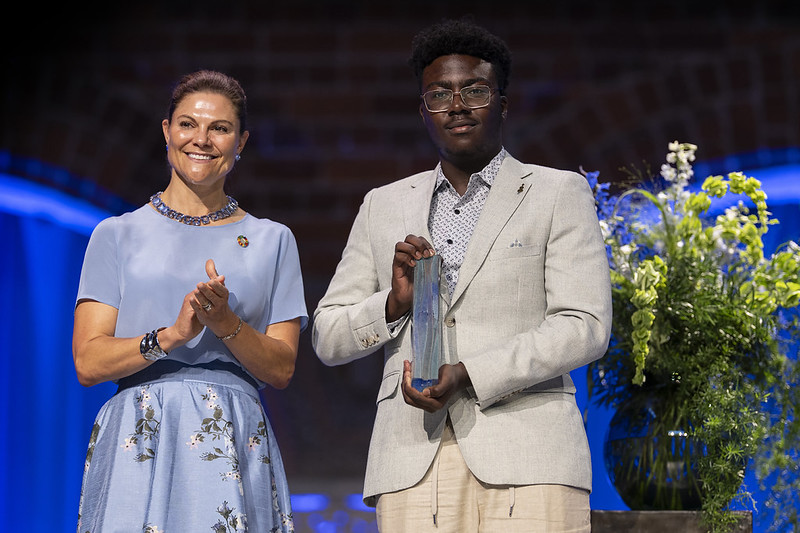
Moroti Adegboyega from St. John’s, NL won the Stockholm Junior Water Prize 2026 for Ecoferroquatics, a platform that uses AI and magnets to selectively remove plastic from water. H.R.H. Crown Princess Victoria of Sweden presented the prestigious award this evening during a ceremony at Stockholm City Hall as part of World Water Week.
The Stockholm Junior Water Prize is the world’s leading international water competition for young people, bringing together national winners from more than 40 countries and building on competitions involving tens of thousands of students worldwide. Since 1997, it has recognised young innovators whose research combines scientific excellence with the potential for real-world impact.
Jessika Roswall, European Commissioner for Environment, Water Resilience and a Competitive Circular Economy said: “Water will define how our future looks, so we have to give young people a voice in shaping its future. By empowering and engaging the next generation of water leaders, we can turn their ideas and ambition into collective action to build a water-resilient Europe for generations to come.”
Hayati Yarkadas, EVP and President, Water Infrastructure at Xylem, said: “I am always inspired by the talent and determination of today’s young water leaders. When I look at the Stockholm Junior Water Prize finalists, I see a generation stepping forward, using science, imagination, and courage to help solve some of the world’s greatest water challenges. On behalf of Xylem, I congratulate all the young leaders who took part in this year’s competition. Their work is a powerful reminder that, together, we have an incredible opportunity to solve water.”
Moroti’s winning project developed an autonomous, AI-guided robot that uses biodegradable ferrofluid, a magnetic liquid and magnets to find and remove plastic from water, offering a way to protect marine biodiversity and public health from the risks posed by plastic pollution. In testing, the system outperformed a simple sieve at collecting the smallest, microplastic-scale particles that usually slip through conventional screening, pointing to an alternative to the manual cleanup methods used today.
Plastic debris in water breaks down into smaller particles, is ingested by wildlife and carries harmful chemicals through the food chain. Existing cleanup methods such as nets, trawlers and filters often damage marine life and rely on heavy manual labour.
In addition to the Stockholm Junior Water Prize, judges also recognised outstanding projects through the Diploma of Excellence and People’s Choice Award.
Diploma of Excellence – Hungary
The Diploma of Excellence was awarded to Laura Ivanka, from Hungary. Laura developed a new system for working with divers to collect macroplastics from the ocean. Her project stood out for its hands-on approach, surveying numerous potential interest groups, developing, testing, and refining prototypes, and even pursuing a patent along the way.
People’s Choice Award – Egypt
The People’s Choice Award, voted on by the global public, went to Basmala Diab from Egypt for turning agricultural waste into a tool for cleaner water and energy.
Basmala’s project converted rice and corn straw into activated carbon to improve microbial fuel cells, systems that use naturally occurring microorganisms to treat wastewater while generating electricity. The upgraded system delivered a significant boost in power density, with expected improvements in pollutant removal and energy output, and won support from voters around the world.
Featured image: Moroti Adegboyega from St. John’s, NL won the Stockholm Junior Water Prize 2026. (Stockholm Water Foundation)