Two landmark 2026 publications — the Water Research Foundation’s global GenAI study and the AI Adoption Framework for the Water Industry — arrive at the same conclusion: the technology is ready, but it’s the workforce that decides whether or not it matters.
By Kalpna Solanki
A workforce at a crossroads
South of the border, the average water worker is 47 years old, and by 2021 roughly one third of U.S. water and wastewater Operators were 55 or older — which is why the Water Research Foundation’s (WRF) new global study on generative AI warns that, on current trends, the sector could lose more than two-thirds of its practical knowledge base within the next decade as retirements accelerate. Canada faces the same squeeze: in British Columbia, 36.3 percent of the water and wastewater workforce was already 50 or older when the EOCP’s sector workforce profile was completed, Operators account for 43.9 percent of upcoming retirements, and roughly 1,150 current workers were expected to retire within a decade.
Meanwhile, a quieter shift is underway. Thirty-one percent of those aged 18 to 29 already use AI on the job — informally, without any training, policy, or oversight — and fewer than one in ten staff are proficient. The gap between what young employees are already doing and what their organizations are prepared to manage is where both the risk and the opportunity live.
These figures come from the same document: The Role of Generative AI (GenAI) for the Global Water Sector (WRF Project 5321, 2026), a one-year study by more than 30 utilities and sector organizations worldwide — from Anglian Water to DC Water — co-sponsored by the American Water Works Association and the Water Environment Federation. Its central finding is disarmingly simple: success depends “not only on data or tools, but on people”. Adoption stalls without a workforce that understands, trusts, and can apply the technology in daily workflows.
Copilot, not replacement
The fear that tops every workforce conversation is job loss. The study’s answer, evaluated across dozens of utility pilots, is that GenAI acts as a copilot: it automates repetitive drafting, paperwork, and data lookups while critical judgment, decision-making, and community engagement stay with people. “Rather than eliminating roles, it strengthens them, making the workforce more capable, confident, and future-ready”, the research team writes.
The report illustrates why with a striking comparison: a large AI model has processed on the order of 60 trillion bytes of data, while the average 47-year-old water worker has absorbed roughly 1.9 quadrillion bytes through a lifetime of lived experience — about 30 times more. The technology’s job is to make that expertise searchable and hand routine work to software.
Canadian utilities are already proving the point. York Region won an American Water Works Association Innovation Award for a machine-learning model that predicts how its sewer network responds to storm events — cutting analysis time by 78 percent and saving roughly $40,000 in labour costs per analysis across the region’s nine municipalities. The model did not replace analysts; it handed them a priority map for proactive maintenance.
There is also a retention warning embedded in the research: utilities that ban or delay employee use of GenAI risk losing talent, because staff who cannot practice these tools fall behind peers at organizations that let them experiment. The study calls the sector’s posture a “crisis of readiness”.
Start with people, not technology
The second document, presented at WEFTEC 2026, is the WRF’s AI Adoption Framework for the Water Industry — “a people-centric step-by-step path from curiosity to sustained results”, adaptable to any utility size or maturity, distilled by Prabhu Chandrasekeran of Arcadis. Its first stage is telling. Spark does not begin with a technology scan or a vendor demo. It begins with interviews: “What is a repetitive task, frustration, or problem you have?” “In your own words, why is this frustrating? What does it cost you, your team, or the process?”.
Only after staff pain points are mapped do utilities move to Shape — co-designing solutions with the human kept in the lead or in the loop — then Launch, prioritizing initiatives into a roadmap, and Elevate: strengthening governance, embedding learning, and scaling safely. The framework defines three collaboration levels, from assistant (human-in-command) to copilot (human-in-the-loop) to agent (human-on-the-loop) — a deliberate answer to the question every Operator asks: who is actually in charge?
The logic is practical: projects chosen around staff pain points get used. Projects chosen around technology do not.
DC Water: five steps, one community
When GPT-4 launched in 2023, DC Water invited around 200 employees to a “Lead & Learn” event to see what the technology could actually do. The result was not a mandate but a volunteer Community of Practice that grew from 30 to about 80 employees across departments and became the utility’s change agents.
Stakeholders — including IT, legal, and cybersecurity — co-drafted the AI policy and data governance strategy. Training started broad and low risk with an AI assistant built into everyday office tools, paired with an embedded AI developer supporting prototypes. Deployment followed a crawl-walk-run path: simple chatbots on trusted internal data first, then voice agents answering customer questions. Each step built the confidence for the next step.
“Change done ‘with’ people works better than change done ‘to’ people.”
Training that fits the tool belt
If adoption is behavioural change, training is where it happens — and one-size-fits-all training is where it dies. The research prescribes layered learning paths: short, ROI-focused briefings for executives and union leaders; hands-on prompt-engineering labs for engineers; short videos, SOP-linked cheat sheets, and mobile voice tools for front-line Operators; gamified microlearning for new entrants.
Canadian leaders describe mentorship as the multiplier. “You can imagine that being a young person, it was very, very daunting”, Vanessa Chau, a senior director at consulting firm CIMA+, told ES&E Magazine. Mentors who “were there for me, and able to guide me, were extremely important” — the human network layered training paths are built to scale.
It also prescribes “translator” roles — pairing subject-matter experts with AI or IT staff — and a pyramid staffing model: many general users and fewer power users. Some tactics are delightfully concrete: Problem-of-the-Month clinics where staff bring routine annoyances and co-build the fix; Shadow-a-Bot days where Operators assess chatbots against real tasks; using LLMs to turn outdated manuals into fresh e-learning. Training, the report stresses, should follow sound data governance, not precede it.
The small-utility leapfrog
For small and rural utilities, the barriers look quite different: every employee wears multiple hats, burnout is widespread, and knowledge lives in the heads of long-serving Operators — rarely documented, and rarely part of succession planning. However, the research argues small systems may be best positioned to leapfrog, the way much of the world skipped landlines and went straight to mobile.
Enterprise LLM access now costs roughly $25 to $60 per user per month and runs on the phones staff already carry. Voice input can initiate work orders; a photo of a meter becomes structured, searchable data. Even safety reporting fits — quick near-miss logs that build trust because they are “meant to keep people safe, not to micromanage them”.
The retention dividend
Every one of these practices doubles as a workforce strategy. Utilities that invest in training, communities of practice, and early wins, are, in the study’s words, best positioned to “attract and retain talent, and preserve institutional knowledge”. The sentiment is seconded north of the border, here in Canada. “In any organization, the biggest strength is the people — without a doubt”, William Fernandes, director of water treatment and supply for Toronto Water, told ES&E Magazine. “You can’t do anything without people, and therefore our employees are the most important part of Toronto Water”. He goes further: “Assets are not just equipment. Assets are humans”.
What comes next — agentic AI systems that plan and execute multi-step tasks — raises the stakes on the same question: keeping humans on the loop, with clear oversight and audit trails. The research agenda now includes national benchmarking of adoption and workforce readiness.
The closing message of the adoption framework could be the sector’s mantra for the decade ahead: AI adoption is an organizational transformation that necessitates behavioural change. Turn infrastructure into intelligence. Turn intelligence into better decisions. In water, that transformation starts where all good projects start — with people.
| Five timeless principles for a changing technology landscape |
| Human-centred — grounded in the daily realities of staff. |
| Purpose-driven — aligned with public health, equity, and safety. |
| Right-sized and modular — scalable for small, medium, and large utilities. |
| Technology-agnostic — defines requirements and pathways, not products. |
| Designed for learning — supports iteration, skill-building, and measurable progress. |
| DC Water in five steps |
| 1. Awareness — some 200 employees attend a “Lead & Learn” GenAI showcase (2023). |
| 2. Inclusion — a volunteer Community of Practice grows from 30 to ~80 employees and becomes the engine of adoption. |
| 3. Buy-in and policy — stakeholders co-draft the AI policy, acceptable use, audit cycle, and data governance strategy. |
| 4. Skills — broad training on an everyday AI assistant, plus an embedded AI developer for prototypes. |
| 5. Execute — crawl-walk-run: low-risk chatbot prototypes on trusted data, then scaled applications such as voice agents for customer Q&A. |
Sources
- Karmous-Edwards, G., et al. The Role of Generative AI (GenAI) for the Global Water Sector. Water Research Foundation Project 5321, 2026. Co-sponsored by the American Water Works Association and the Water Environment Federation. Principal investigators: David Hale and Dawn Flancher (AWWA), Fidan Karimova (WEF), Gigi Karmous-Edwards (Karmous Edwards Consulting). waterrf.org
- Chandrasekeran, P. (Arcadis). “Workforce Augmentation,” WEFTEC 2026 session “AI and the Future of the Utility Workforce,” presenting the AI Adoption Framework for the Water Industry.
- Davey, P. (ES&E Magazine). “Asset management and diversity, equity and inclusion go hand in hand” — interview with William Fernandes (Toronto Water), Vanessa Chau (CIMA+), and Troy Briggs and Brian Sudic (CIMA+). esemag.com (via eramosa.com).
- infinitii ai. “Planning AI-driven water projects in 2024? Four industry case studies” — York Region Inflow and Infiltration Reduction Strategy (AWWA Innovation Award); SCG Flowmetrix/Region of Peel Flow and Rainfall Data Delivery project. infinitii.ai.
- Environmental Operators Certification Program (EOCP). Water and Wastewater Sector Workforce Profile (full report) and Water and Wastewater Sector Workforce Strategy, Executive Summary (October 2017). eocp.ca. Figures cited: 36.3% of the BC sector workforce aged 50 and over; Operators account for 43.9% of upcoming retirements; roughly 1,150 current workers expected to retire within a decade.
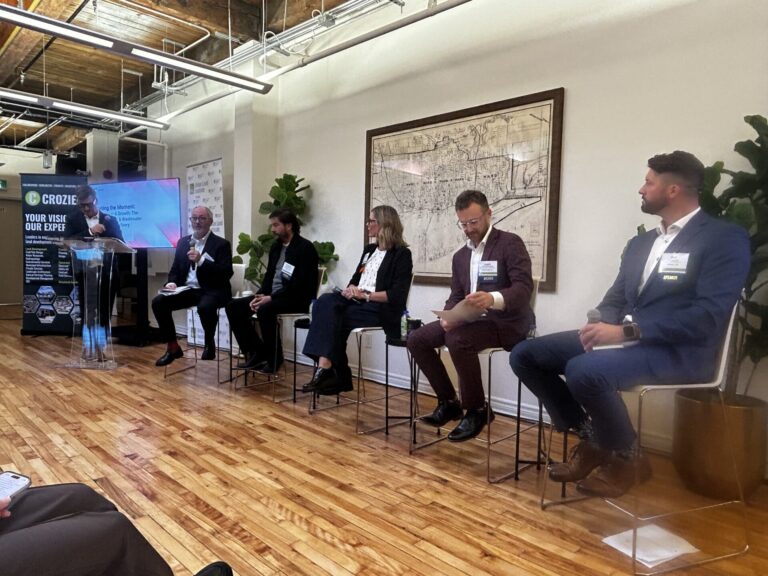
About the author: During her tenure as President and CEO of the Environmental Operators Certification Program (EOCP), Kalpna Solanki led the British Columbia water and wastewater sector workforce profile and strategy cited in this article. She also presented on AI in the water sector and participated in a panel discussion moderated by Gigi Karmous-Edwards, the study’s lead author, following her keynote at the Water Environment Association of South Carolina conference. Kalpna Solanki is currently the President and CEO of GAMEHCANGERS Inc., a consultancy based in British Columbia. GAMECHANGERS partners with leaders who are ready to evolve in strategy, governance, and capacity, including the practical adoption of AI to sharpen decision-making, strengthen asset management, and build operational resilience.
Proofreading and source-checking for this article were assisted by QI, an AI assistant; all final judgments on content and sources are the author’s.