A new study points to drugs in wastewater as a new set of compounds affecting freshwater fish in rivers.
Researchers at the University of Waterloo have found several chemical substances such as opioids and anti-depressants are present in Ontario freshwater fish living downstream from treatment plants.
University of Waterloo department of biology professor and Water Institute researcher Dr. Mark Servos said a concurrent study about harm reduction led to testing whether drugs present in wastewater affected aquatic populations and added pharmaceuticals in water have been a focus of study generally for some time.
“They’re not always illicit drugs, for instance fentanyl can be used in hospitals, but they’re high-risk and can also be used illicitly,” he said. “Our question was can we develop methods measure (the compounds) that are of concern for health reduction and then turn around and see if they’re in the environment, with this being the first study to see if the substances were in the tissue of the fish.”
Three different types of fish were studied, Servos said along with both sexes of each type of fish.
One site was used for this study, Servos said, but similar measurements have been found at other sites.
“The bottom line is if there’s water being discharged, it’s likely you’ll find chemicals of concern including these kids of chemicals in the environment,” he said.
Currently wastewater plants are not set up to screen or filter chemicals such as opioids, but “there are lots of compounds entering into the environment, many of which we are yet to identify and understand because society is continually generating new compounds of concern.”
Other jurisdictions such as Europe have studied how to removes some of these compounds from wastewater, he added, but the cost comes in terms of energy so it’s important to determine levels of risk.
“What is the prevalence of the compounds, what kind of compounds are they, what is the risk to the environment and then based on that balance the trade-offs between energy and costs so you get the net benefit to society,” Servos said.
Dr. Meghan Fuzzen, a research associate in Dr. Servos lab said concentrations of drugs in the fish they studied are quite low but “we’re still doing experiments to determine how much uptake (of compounds) there is from the water into the fish and what those levels mean for the fish’s health. We still have work to do to see if it’s impacting fish in the wild at these low concentrations.”
University of Waterloo postdoctoral fellow Dr. Diana Cárdenas-Soracá said proper techniques and equipment are needed to detect compounds such as fentanyl and other opioids in bodies of water and and fish are very complicated matrices with biomolecules that can interfere with analysis.
“We need to spend some time and effort to be able to remove that interference and see if the signals we’re seeing correspond to the compounds we’re interested in,” Cárdenas-Soracá said.
While scientists can study the effect of drugs on water-based animals, Cárdenas-Soracá said, techniques are not yet available that can isolate only one compound for study.
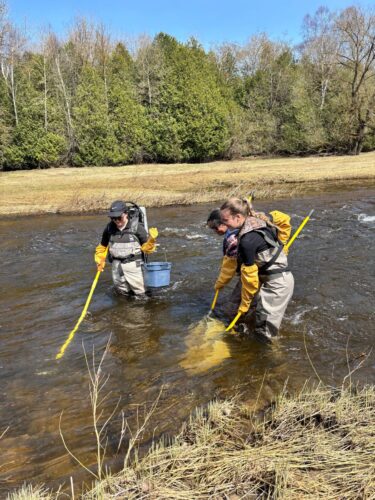
University of Waterloo researchers in the field gathering samples to study the effects of opioids and other compounds on freshwater fish. (University of Waterloo)
“We have to balance how much we can quantify with how much we can invest to remove points of interference that will potentially disrupt our analysis,” she said.
She added while the group is working with a hypothesis that female fish are less affected by the compounds due to ‘decontaminating” their systems when laying eggs, they have not yet determined that is fact.
“Some of these compounds are hydrophobic, meaning they stick to lipids and thus the compounds will interact more with eggs. When the female releases the eggs it is something like decontamination,” Cárdenas-Soracá said.
Fuzzen remarked that the compounds do act on fish brains and “the fish have very similar mechanisms to humans such as the serotonin and epinephrin receptors that we have.”
“There’s potential for disruption of growth and reproduction when there’s a lot of these compounds present working in similar manners,” she said.
Fuzzen added the group is studying how compounds affect behaviours such as response to predators and social cues “which could alter their ability to survive in the end.”
Conversely, Cárdenas-Soracá said, “the fact the compound is in the fish (may or may not) mean it will impact the fish. We’re trying to understand what the impact is.”
Servos said previously animals were not a focus of study because the analytical capabilities to do so were not yet available.
“Now we know it’s in the wastewater, the river and getting into the animals and the question is, does that matter? If you look at the bigger picture, anything going down a toilet or a drain is going to the wastewater treatment plant and the plants just can’t keep up with the diversity of material that society is generating,” he said.
“We need to be vigilant as to what is going down that drain and working towards solutions or at least understand what it is we’re doing to the environment,” he added.
Servos added any new chemical going down the drain just adds to the amount of compounds interfering with bodies of water.
“We’ve got pesticides, organic contaminants, habitat change..we have all these things going on in the environment and our obligation is to understand what it’s doing so we can protect sustainability and make sure the next generation has the opportunities that we have,” he said.
In the case of the fish examined in the University of Waterloo study, Cárdenas-Soracá said, there was little movement and “we went with the worst case scenario. They don’t move too much and since they’re in a certain spot of the river, they’re constantly exposed to these compounds.”
“There’s a potential since the fish don’t move that we’ll see the compound in the fish if the compound is still there, so given three easy to find species in the river, let’s see if we can see differences between them,” she added.
Further information may come to light regarding the effect of opioids and other compounds with further study of different fish species with varying physiologies, behaviours and in different locations, she added.
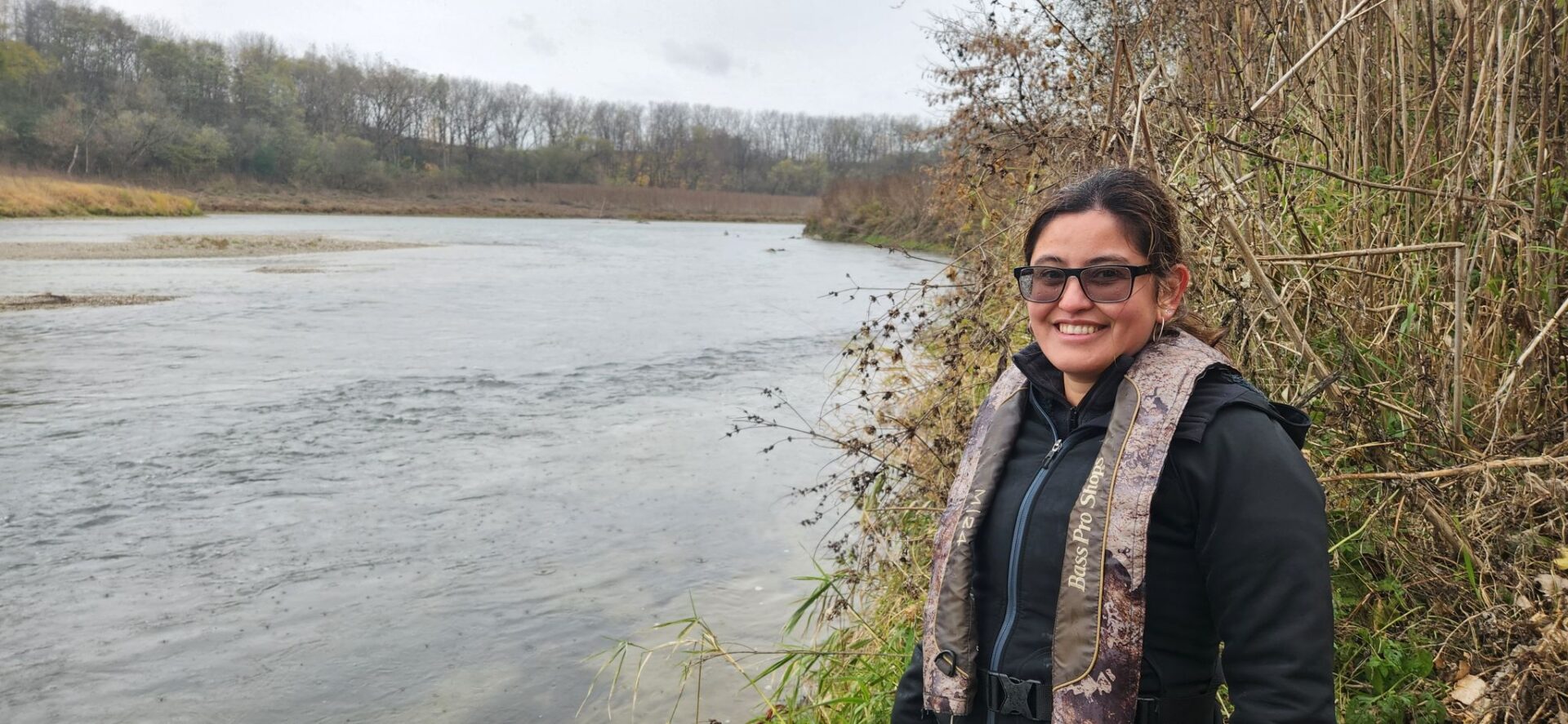
Featured image: University of Waterloo postdoctoral fellow Dr. Diana Cárdenas-Soracá. (University of Waterloo)