When the Chippewas of Nawash Unceded First Nation, in Neyaashiinigmiing on the southern shore of Georgian Bay in south-central Ontario, embarked on a four-year endeavour to build a new water treatment plant and significantly overhaul its water delivery infrastructure, the community of more than 800 people had high expectations of ending a long-standing boil-water advisory.
The old treatment plant, commissioned in 1990, had many assets working in its favour, including coagulation and flocculation systems, two booster stations, a wet well, pressure filters, and a 454-cubic-metre water tower. However, the plant showed its age and frequently reaching operating capacity, with pressure so low that many hydrants lacked sufficient flow for firefighting. Furthermore, the 27-kilometre network of distribution pipe was losing 60 to 70 per cent of its supply to leakage, with close inspection revealing some of it built from substandard materials. Factor in water intakes clogged by zebra mussels, obsolete filtering equipment, lack of chlorination, no backup power to the plant, and the need to accommodate a growing population, Nawash councillors decided on a complete overhaul.
The boil-water advisory, implemented in 2019, was the last straw. But water treatment plant supervisor Devin Wilhelm says the advisory didn’t reflect a sudden crisis so much as it was to acknowledge that Ontario water treatment plant standards had strengthened over time, and that the system was built about a decade before the catastrophe in the nearby Town of Walkerton shone a spotlight on water protection.
While First Nations generally follow federal water treatment guidelines rather than provincial regulations, Nawash issued the advisory because Ontario drinking water regulations 169/03 and 170/03 offer a more stringent, reliable standard for safety and potability. “Essentially, the reasoning behind our putting the boil-water advisory in place was due to the fact that the old water treatment plant did not meet the standards of the time,” Wilhelm says. “Ontario’s standards are among the strictest water legislation in the world.”
Nawash public works teamed up with the Ontario First Nations Technical Services Corporation (OFNTFC) to conduct feasibility studies to choose an appropriate course of action, and project planning began in earnest in January 2020. Nawash retained Associated Engineering to complete detailed design for a new treatment plant, an underground reservoir, a new 300-metre intake into Georgian Bay, an upgrade to existing watermains, a 14.5-kilometre watermain expansion, a new access road, and robust hydro, internet and telephone connections to the new plant site. The project team then secured a $61-million capital funding commitment from Indigenous Services Canada (ISC), with the band budgeting an additional $700,000.
Three months into planning, however, the project team faced its first major challenge when the First Nation closed to visitors to help keep COVID at bay. With outside site access no longer feasible, the project team turned to online videoconferencing and cloud-based 3D collaboration software. “Associated Engineering was able to generate some pretty accurate walk-throughs so that they were able to present to the capital works manager, the water treatment manager, and our chief and council,” Wilhelm says.
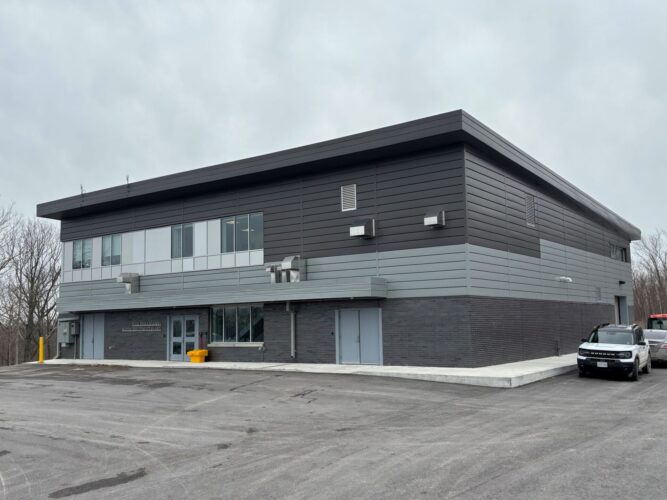
As the pandemic eased and restrictions gradually ended, the project team carried out detailed design and chose a site on band-owned land five kilometres downstream from the legacy plant so that both plants could function independently from one another during construction. In the spring of 2022, crews cleared forest growth to make room for the new plant, adjacent low-lift pumps, and high-density polyethylene pipe going down a steep incline to draw from new intakes in Georgian Bay. “They essentially drilled a giant tunnel from the top of the hill down towards the low-lift pumps and then into the bay,” Wilhelm explains. “They took out a massive amount of rock and had to dig deep to get the necessary depth for the reservoir and everything else for the water treatment plant.”
To stop zebra mussels from clogging intake pipes, crews installed a brand-new pre-chlorination system
—a line that doses the mussels with a minute amount of sodium hypochlorite when routine summertime inspections spot troublesome concentrations of the invasive species. “If there’s more accumulation than expected, the inspection team will scrub clean all the zebra mussels,” Wilhelm says. “That’s essentially what we did at the old plant, when our pre-chlorination system wasn’t working.”
Another key project component is a new UV system to replace one that was malfunctioning. “The old one had six lamps that were about four feet long, and the new one has just two lamps that are about a foot long, so they’re more efficient and have a smaller footprint,” Wilhelm says.
New low-lift pumps also mark a considerable improvement. “Our old plant was all pressurized, so our flocculation, sedimentation and filtration weren’t the best. We’ve now fully optimized it, and it’s producing very clean water in terms of turbidity.”
Storage capacity has also more than doubled. The new water tower holds roughly 454,000 litres, and the new reservoir underneath the treatment plant, when full, holds an additional 600,000 litres. “We didn’t have a reservoir before, so that was a big vulnerability,” Wilhelm says. “If you don’t have a reservoir, you don’t have any contact time. In every water treatment plant, your chemicals interact with the water for a certain amount of time to give you the proper results that you need. The old water treatment plant never met those requirements, but the new plant meets them tenfold.”
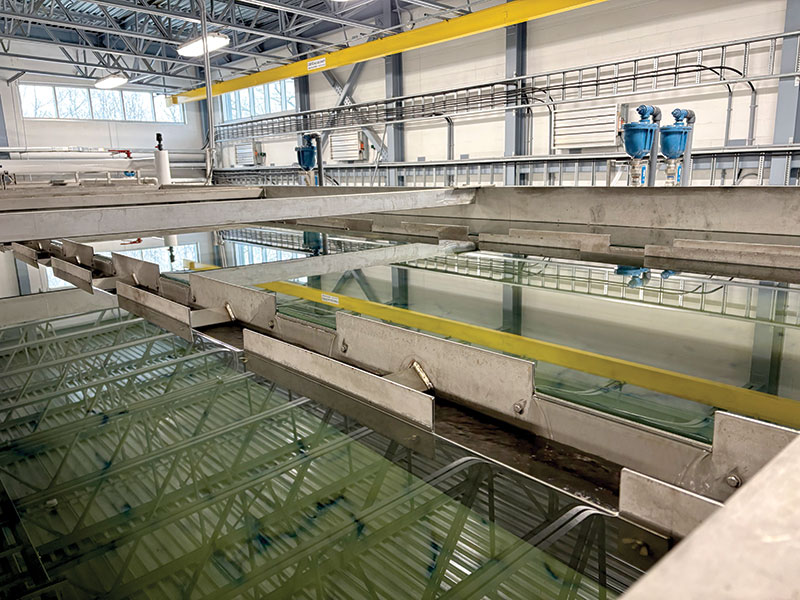
The project centerpiece, of course, is the new plant itself. Wilhelm describes it as a conventional treatment system with up-flow clarifiers, two sets of filters—one mixed-media filter with anthracite and sand, and a second carbon filter designed to tackle taste and odour issues. The plant also has a supervisory control and data acquisition (SCADA) system. “It’s standard in a lot of plants and factories,” Wilhelm says, calling it the brains of the operation.
As with any new technology installation, the project team encountered minor hiccups integrating
SCADA with the filtration system. “Everything just had to line up, and when you’re working with different sets of codes that can be a challenge,” Wilhelm says. “But we have about 99 per cent of all that ironed out.”
The other major facet of the project was to address leaks which were draining a staggering 650,000 litres daily from the system’s 27-kilometres of mostly PVC distribution pipe. That’s roughly 60 to 70 per cent of the overall supply, and the pre-construction inspection in 2020 discovered farm-grade pipe and even small lengths of garden hose, mostly where the system connected to private dwellings. Wilhelm describes some leaks as lower pressure-rated pipe developing pinhole-size leaks, and some instances where installation wasn’t done properly. “The leaks would develop and get bigger over time.”
Crews repaired the leaks they found, bringing sub-par sections up to code, and added an additional 14.5 kilometres of watermain to the network. “We had 300 service connections redone to service every single residence and band building,” Wilhelm says. “And we installed two valve chambers for the booster stations, an isolation chamber to separate our distribution system into two different pressure zones, and about 100 new fire hydrants,” Wilhelm says.
The project also brought the typical logistical challenges that occur with many water projects. When service lines needed to be disconnected for more than a few hours, the water department installed temporary above-ground watermains which drew from fire hydrants. The project team even briefly ran a water bottle distribution program. The transition between the old and new plants went smoothly, with valves installed to operate each system in isolation. “On the day of the switchover we opened the valves for the new plant, closed the valves for the old plant, and then ran the new system,” Wilhelm says. “We never lost any of the pressurization from the old plant, so the switchover was fairly seamless.”
When the plant went live in October 2024, the plan was to continue system tests and lift the boil-water advisory once given the all-clear. Five months later, however, even as crews concluded repairs to what they thought would be the final remaining leaks, a considerable number of new ones opened across the system, bringing water loss numbers back to roughly where they were pre-construction. “We were in very good spirits after the plant was commissioned,” Wilhelm says. “We got through the wintertime no problem, everything was running great, and then we had all these leaks open up. We have ideas of where they are but haven’t pinpointed them all yet.” A complicated topography with considerable rock and clay doesn’t help. “In some cases, we might have a leak open up in one location but not see the water for a kilometre or more,” Wilhelm says.
The project team is engaging a third-party leak detection specialist to help plan next steps. “It will likely be one of those things we systematically take care of it as much as we can and as quickly as we can, but it’s probably going to take a few years to tackle all of it,” Wilhelm says, not ruling out the need to replace entire swaths of piping, or even the entire distribution network.
While the integrity of the distribution system remains unknown, the community has the clear advantage knowing the new plant, in producing clean, potable water, ultimately facilitates whatever work might remain on the distribution side. “With the leaks we have right now, the old plant would not have been able to keep up, whereas we’re now pretty much able to keep up with demand,” Wilhelm says.
Saul Chernos is a freenlance writer for Water Canada.
[This article appeared in the May/June 2026 issue of Water Canada.]
Featured image: The new Enji Biinaagamig Water Treatment Plant features a conventional treatment system with up-flow clarifiers and two sets of filters. (Devin Wilhelm)