Experts agree: Calgary’s multiple watermain woes were inevitable.
Siegfried Kiefer led an independent panel who examined the causes of the 2024 Bearspaw South Feeder Main failure and gathered their conclusions in a recent review recently released to the public.
Keifer said the review found not only was the infrastructure itself prone to failure but that several administrations did not address the vulnerability of the system for a variety of reasons.
“This particular era of 1970s re-stressed concrete cylinder pipe (PCCP) has been known in the industry for some time to have some design flaws relative to its longevity and in particular has been known to be susceptible to toxic soil conditions,” Kiefer said. “A failure along this line shouldn’t have been that big of a surprise.”
University of Alberta engineering professor Alireza Bayat said the incidents in 2024 and 2025 had similar causes and while efforts were made in 2024 to repair damage it shifted the risk to other parts of the network.
“It’s a ‘zipper effect,’” Bayat said. “You fix a part and stress moves to another part. All in all, you have a pipe in soil and an environment that can no longer handle it.”
Kiefer said the panel found that over the years, despite the City of Calgary having an earlier experience with the McKnight pipe failure in summer 2004, “a pipe of the exact same vintage as the Bearspaw South Feeder Main, and despite post incident reporting enhanced inspections and soil testing those actions were not acted on.”
Repeated risk reports highlighted the Bearspaw pipe had a known risk to its integrity, and “somehow management convinced itself that it had a low probability of failing because the pipe ran along the Calgary riverbed and toxic soil conditions would not accumulate in any significance around the pipe,” Kiefer said.
“The only soil sampling we could find in city records happened in 2014 and while the pipe does run along the riverbed and you’d think most liquids would wash out into the river,” Kiefer said.
“The fact that it runs along the Trans-Canada Highway and a lot of chemicals are used to keep it ice-free, in hindsight they should have been testing along the pipe a lot more frequently and in a lot more locations and that would probably have sparked a bit more concern in terms of the risk of failure for them,” he said.
Kiefer added because the feeder main was seen as a low-probability risk, inspections and maintenance were directed to other parts of the network deemed higher risk but with a lower consequence of failure.
“High consequence failures are the things you’ve really got to worry about because even if they are low probability, the fact that they have such an impact is what really should have you take extra precautions which is really in the fundamentals of operating essential service utilities,” Kiefer said.
He added councils deal with budgets, election issues, affordability and pressure to minimize rate increases “but that at times is inconsistent with the long-range planning you need to do to make sure your system stays robust enough to have the resiliency to route water flows through other feeder mains.”
“Calgary since 2004 had been deferring reinforcement projects that would have perhaps not eliminated the total risk on Bearspaw but would have given some alternate flows other than the Glenmore Reservoir as the backfill for a failure on that line,” he said.
The Glenmore Reservoir is also seasonal in its capacity, Kiefer added, with inflows in the winter barely enough to meet the outflow obligations of the dam.
“The reservoir is a pretty static body of water through the winter, doesn’t expand and if you start to draw it down the capacity that’s there in the winter is about five weeks of being able to supply roughly million litres per day,” he said.
“We all recognize when we first put in a new piece of infrastructure typically it has more capacity than you’re using at the outset and that clearly was the case in the 1970s when the Bearspaw South feeder main was put into service,” Kiefer said. “But given the growth from 1975 to 2025 that artery became pretty much life-sustaining to the water network in Calgary.”
Bayat said underground water infrastructure degrades as it ages and if it’s a smaller pipe, “you dig up the street and fix it. The consequence for failure isn’t high.”
“But this is a transmission pipe. It’s a louder alarm and once it fails, the whole city is challenged,” he said.
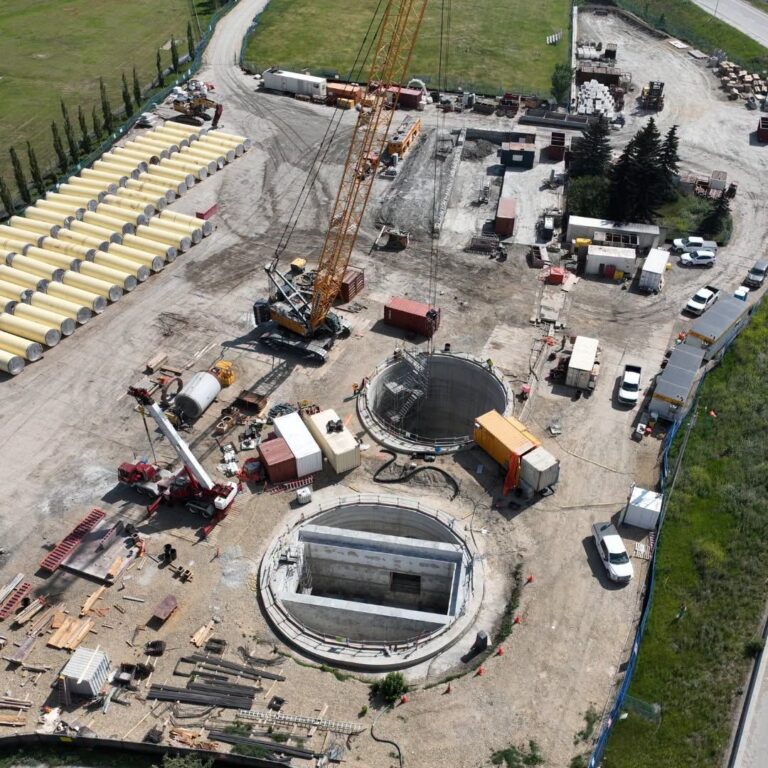
The City of Calgary announced Jan. 22 it has implemented a revised plan that “urgently expedites construction of a replacement for the Bearspaw South Feeder Main (BSFM) due to the critical condition of the current pipe and its importance in Calgary’s drinking water system.”
“The project will add a parallel steel pipe of the same size as the existing BSFM. Over time, this new pipe will take over service from the current line. The replacement pipe is now anticipated to be completed in December 2026,” the release said.
Kiefer said aging infrastructure in Calgary and across the country needs to be maintained over decades which doesn’t always mesh with the immediate needs of municipal government.
“It’s an easy trap to fall into. Politicians have a four-year term, they’re trying to maximize impact on the community in those four years, and they don’t get rewarded for building something that will serve the community well 15 years from now. They just get criticized,” he said.
“That’s really why you have to get an accountability structure that allows this type of critical infrastructure to be managed by a team dedicated to it and overseen by a governance structure that is long-term focused, not near-term or ‘this election cycle’ focused,” Kiefer said.
The panel has recommended the City of Calgary set up a water utility department and an oversight board independent of council and administration, “but ultimately move to a municipally controlled corporation and permanently entrench a formal board of directors that have fiduciary duties to the long-term health and welfare of the business.”
Council would still retain the ability to regulate the corporation, Kiefer added, set service levels and target areas of growth in the city.
“We don’t see it as a diminishment of council’s authorities, we see it as a tremendous improvement in the governance, oversight and management accountability,” he said.
Bayat added that aging infrastructure is a national issue, but every municipality approaches the problem differently.
“Every municipality has its own practice, and we don’t have a national way of doing things. Calgary is one of the good ones. Smaller municipalities don’t have the resources Calgary has (available),” Bayat said.
From an engineering perspective, he added, the condition of infrastructure has nothing to do with politics.
“Pipes don’t care who writes the paycheque. At the end of the day, you have to go and fix it,” he said. “Pipe is pipe. We have to know the condition of pipes and take care of them before we fail.”
He added that the impact of clean water on public health cannot be overestimated.
“Clean water has saved more lives than any other advancement in the medical field. It’s saved a lot of lives and is fundamental,” Bayat said.
Warren Frey is the Associate Editor of Water Canada.