Pikangikum First Nation has renewed a state of emergency over its collapsing water and wastewater systems nearly one year after first declaring the crisis, citing continued federal inaction despite repeated requests for intervention.
The community’s only water treatment plant operates beyond capacity, with more than 300 homes without direct water service. Daily water rationing and forced evening shutdowns persist, affecting drinking water, sanitation, health care, education and fire protection. The situation has worsened due to severely aged intake and distribution lines deteriorating rapidly underground.
On April 24, water treatment plant operators reported the community’s reservoir had dropped to critically low levels. Investigations revealed inflow of filtered water to the plant is currently less than two litres per second, while outflow to the community is 7.8 litres per second—meaning the reservoir loses water at a rate roughly four times greater than it can be filled.
The community relies on an average of 20 to 25 water truck deliveries daily to serve roughly 300 homes dependent on hauled water. Yet these deliveries reach only 40 to 50 homes per day, requiring a full week to provide water to all affected residents when supply permits. Operators struggle to refill the reservoir fast enough to meet demand even with strict community-wide water conservation measures in place for nearly two years.
Pikangikum formally declared a state of emergency on May 8, 2025, and filed a Notice of Motion in Federal Court seeking urgent relief to compel Canada to address critical failures in water, wastewater and fire-prevention infrastructure. On Feb. 11, 2026, Pikangikum wrote directly to the Prime Minister and the Minister of Indigenous Services requesting urgent intervention and an emergency meeting to devise a comprehensive action plan. That request has not been answered, the Nation said in a news release.
“Canada has been fully aware of the severity and urgency of this crisis for years,” Chief Paddy Peters said. “We declared a state of emergency, we went to court, we provided study after study, and we wrote directly to the Prime Minister asking for immediate action. Nothing has changed on the ground for our people. No community in Canada would be expected to live like this.”
Peters added: “Our people are being asked to wait while their health, safety, and dignity are put at constant risk. The federal government’s continued inaction speaks for itself: We have a disaster unfolding right before our eyes.”
Pikangikum First Nation said the crisis is not new, not unforeseen and not due to a lack of studies or information, but rather the result of prolonged federal inaction.
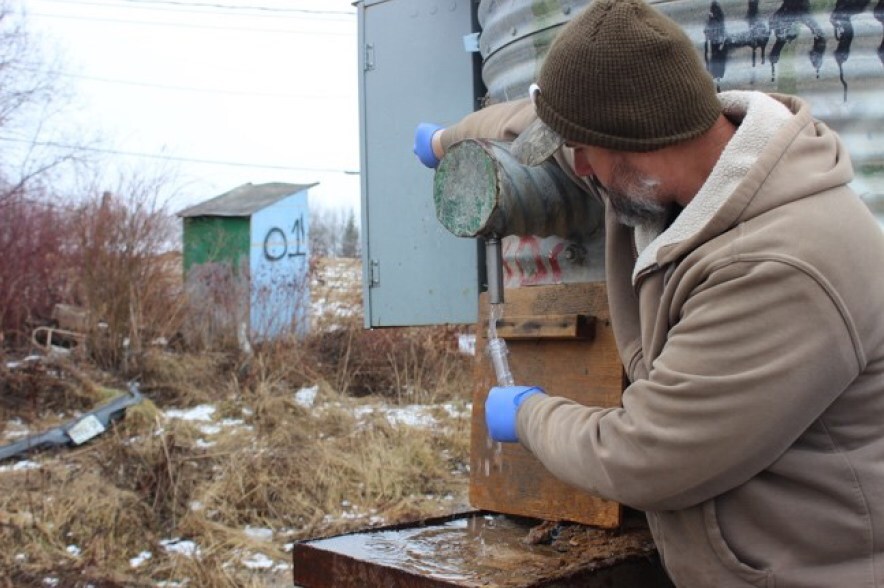
Featured image: Photo courtesy of Nick Saddler, Blackbay Investigations – testing water samples at Pikangikum (CNW Group/Pikangikum First Nation)