If you ask anyone in the water sector what keeps them up at night, you’re bound to hear a four-letter acronym: PFAS. Per- and polyfluoroalkyl substances have officially evolved from a niche regulatory headache into one of the greatest environmental and engineering puzzles of our generation.
The science is moving fast, but the chemicals are moving faster. So, how does Canada get ahead of a contaminant that refuses to break down?
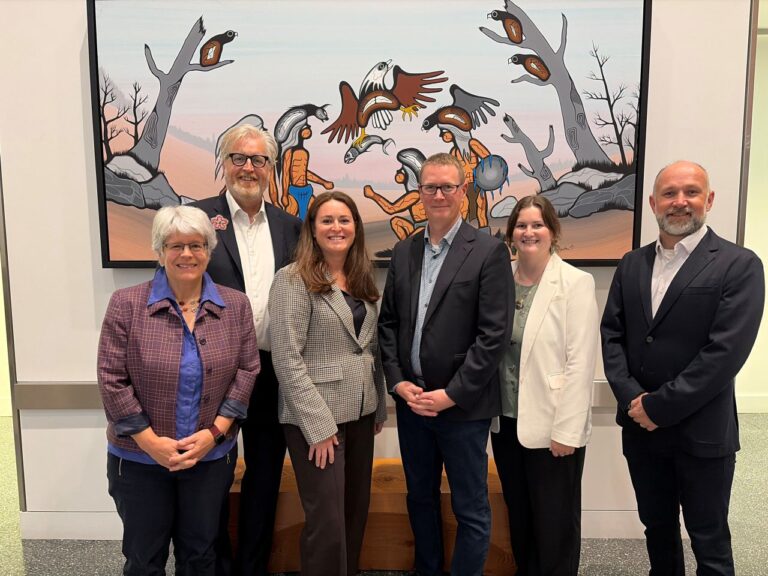
To find out, 125 of the country’s top minds across government, academia, and private industry packed into a room at Toronto Metropolitan University (TMU) for the PFAS Management in Canada Workshop. Co-organized by Urban Water TMU, the Ontario Water Consortium, Pollution Probe, and the Canadian Water and Wastewater Association (CWWA), the full-day event bypassed the usual polite slideshows. Instead, they brought competing sectors together to sit at the same tables and answer the hard questions.
Here are the biggest, unfiltered takeaways from the front lines of Canada’s PFAS battle.
1. Stop trying to catch smoke
For decades, the standard response to water pollution has been “end-of-pipe” treatment—waiting for a contaminant to hit the plant and then filtering it out.
The consensus from the workshop? That strategy will bankrupt us. The sheer cost of scaling up detection, removal, and destruction technologies across every municipality is staggering. Workshop participants overwhelmingly agreed that Canada needs to switch to a source protection framework. In plain English: we need to stop trying to catch the smoke and just put out the fire.
The Stepwise Strategy Proposed:
- Phase it out: Ban PFAS in consumer products where safer alternatives already exist.
- Question what’s “Essential”: For everything else, determine if the use is actually critical to public health, safety, or societal survival (think medical equipment vs. stain-resistant carpets).
The federal government is already nodding along; its March 2025 Proposed Risk Management Approach for PFAS explicitly flagged this “essential vs. non-essential” concept. Workshop tables even suggested creating an international ISO standard to legally define what counts as “essential,” ensuring that permitted uses face a ticking clock and mandatory periodic reviews.
2. Who pays the bill? (Hint: Not the municipalities)
When it comes to funding the massive infrastructure overhaul required to clean up PFAS, the room was undivided: the polluter must pay.
Participants loudly championed Extended Producer Responsibility (EPR) frameworks. If an industry profits from manufacturing or using PFAS, they should bear the lifecycle cost of its disposal and environmental remediation. Shifting this financial burden would instantly incentivize chemical companies to invest in cleaner, safer alternatives.
That said, the scale of the crisis means the public sector can’t just sit on its hands. To de-risk private innovation, attendees called for targeted government grants, tax incentives, and venture capital programs—mimicking models like the U.S. Superfund Program.
3. The biosolids dilemma: Circular economy vs. chemistry
Perhaps the most fascinating tension of the day centered on wastewater treatment plants (WWTPs).
Right now, WWTPs are caught in the crossfire. They don’t create PFAS, but they are a primary destination for it. If we use aggressive, blanket filtration to pull PFAS out of wastewater, we risk destroying the beneficial reuse of sludge and biosolids as agricultural fertilizers—wasting crucial nutrients like phosphorus.
The room advocated for a systems-based, circular economy perspective. We shouldn’t view wastewater as a waste stream; it’s a resource. The path forward requires investing in “smart tech”—systems running in series that can separate and destroy PFAS while keeping nutrients and moisture intact, or converting the remainders safely into alternative products like biochar.
If we get this right, advanced filtration could simultaneously clean the environment and safely output water that meets strict drinking-water standards—a massive win for water-stressed regions.
4. Cutting the Red Tape with a New Secretariat
Because environmental governance in Canada is famously fractured across municipal, provincial, and federal lines, policy can move at a glacier’s pace. Meanwhile, new chemical variations hit the market constantly.
To bridge the gap, one group put forward a highly practical logistical fix: establishing a dedicated Federal-Provincial PFAS Secretariat under the Council of Canadian Ministers of the Environment (CCME). A single, unified body could harmonize regulations, slash bureaucratic delays, and get academia, government, and industry talking to each other in real-time.
What’s next? The conversation continues this month
The clock is ticking. While the foundational findings from that initial workshop set the stage, the strategy is actively evolving. If the TMU workshop proved anything, it’s that Canada’s water sector isn’t waiting around for a “forever” timeline to dictate our future. The solutions—from eco-labelling programs to cutting-edge pyrolysis destruction—are on the table. Now, it’s a matter of shifting from ideas to a concrete roadmap.
To hammer out that plan, the sector is reconvening. On June 16, 2026, Urban Water TMU is hosting an in-person symposium at Toronto Metropolitan University: Governance and Technical Strategies for PFAS Management.
Supported by partners like the Ontario Water Consortium, Pollution Probe, and Water Canada, alongside sponsors Purifics, Veolia, and ALS, this session will tackle:
- The Federal Game Plan: Breaking down the Government of Canada’s risk management strategy and coordination framework.
- The Tech vs. The Ledger: Evaluating actual PFAS removal and destruction technologies against a harsh analysis of risks, challenges, costs, and availability.
- The Biosolids Pivot: Treating wastewater plants as resource-recovery opportunities rather than just liability zones.
- Global Intel: Reviewing the latest technical and governance advancements out of the European Union to see what Canada can copy.
If you’re interested in being part of the conversation at this in-person event. Scan the details or register directly at tinyurl.com/PFAS-Symposium.