When water infrastructure works as intended, it stays invisible. Taps turn on, toilets flush, and rain drains away without a second thought. But behind that seamless daily reality lies some of the most complex, high-risk civil engineering taking place in North America today.
Digging deep beneath urban centres, tunnelling through mixed rock beneath active ocean inlets, and overhauling generational wastewater plants requires solving problems that textbook engineering never fully prepares you for.
In Water Canada’s recently released Top 50 Water Projects report, the scale of these developments is staggering. Here is an inside look at three of the multi-billion-dollar giants featured on this year’s list.
1. Under the Inner Harbour: Don River and Central Waterfront Project (ON)
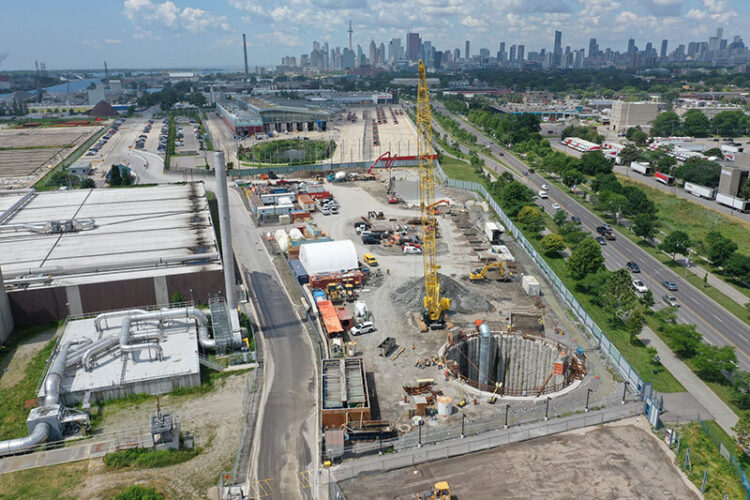
Tackling Toronto’s century-old combined sewer system is one of the largest underground infrastructure initiatives in Canadian history. Spearheaded by the City of Toronto with an overall budget exceeding $3 billion, this multi-phase program is designed to capture, store, and transport wet-weather flows to prevent raw sewage and stormwater from spilling into the city’s waterways.
At the heart of the integrated network is the Coxwell Bypass Tunnel—a 10.5-kilometre-long, 6.3-meter-diameter cavern bored deep beneath densely populated urban neighbourhoods. Designed by consultants Black & Veatch Canada in association with R.V. Anderson Associates, and excavated by contractor North Tunnel Constructors (a joint venture of Jay Dee Contractors, Michels Canada, and C&M McNally Tunneling), the tunnel ties into five massive vertical storage shafts. Altogether, the subterranean network will provide over 600,000 cubic meters of storage capacity.
Navigating the sub-surface layout has been a spatial puzzle: crews had to thread the needle around active subways, legacy utility corridors, and shifting soil conditions. Further downstream, general contractor Graham Construction and engineering lead AECOM are completing a massive high-rate UV disinfection facility at Ashbridges Bay. Once fully commissioned, the system will intercept overflows from dozens of legacy outfalls, dramatically restoring water quality across Taylor-Massey Creek, the Lower Don River, and Toronto’s Inner Harbour.
2. Deep Under the Inlet: Second Narrows Water Supply Tunnel (BC)
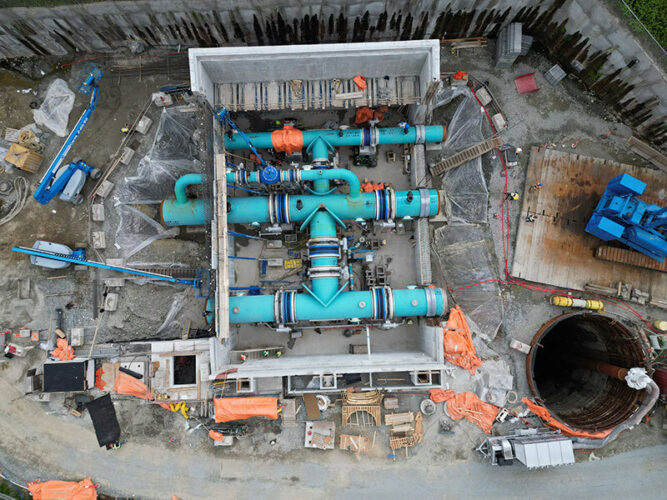
Replacing 70-year-old water mains vulnerable to seismic activity and riverbed scour is no easy task when those mains lie underneath an active ocean inlet. Metro Vancouver (Greater Vancouver Water District) commissioned the Second Narrows project to bore a 1.1-kilometer tunnel featuring a 5.5-meter inside diameter, buried up to 30 meters beneath the bed of Burrard Inlet.
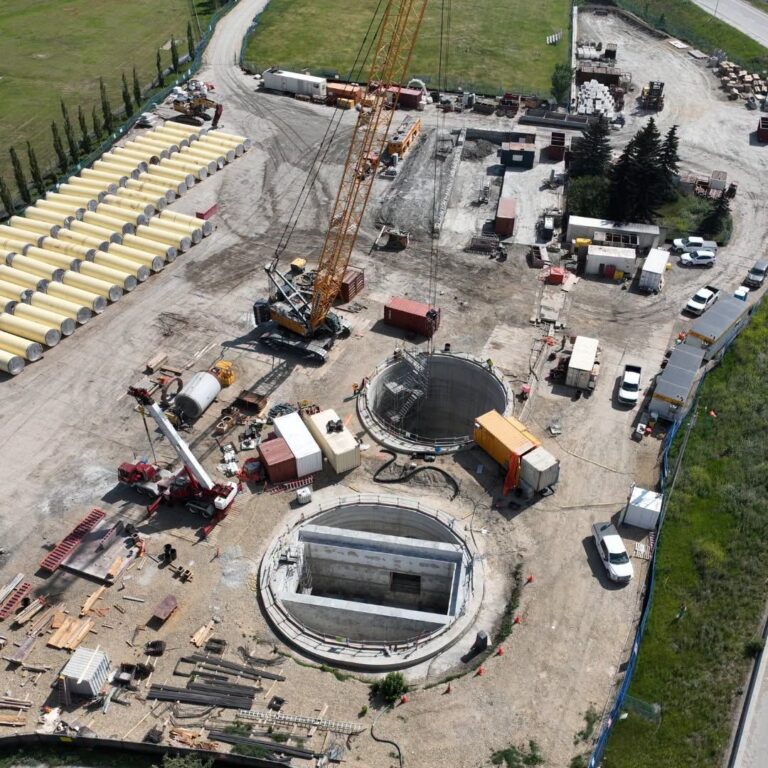
The technical hurdles were extreme. Delivered by the Traylor-Aecon General Partnership (a joint venture of Traylor Bros. and Aecon Group Inc.), crews launched a specialized Slurry Tunnel Boring Machine from a 16-meter-wide, 60-meter-deep launch shaft in North Vancouver. The TBM drove through unpredictable geology—ranging from loose granular soil and boulders to hard sedimentary rock—under intense groundwater pressure reaching 6.5 bar, before meeting a 110-meter retrieval shaft on the Burnaby shore.
Inside the concrete-lined tunnel, crews installed three massive welded steel water mains (one 1.5-meter and two 2.4-meter diameter pipes) fully encased in cellular concrete. Designed for a 100-year service life, the system is engineered to withstand a 1-in-10,000-year earthquake, guaranteeing a secure drinking water supply for over 1 million residents across six municipalities.
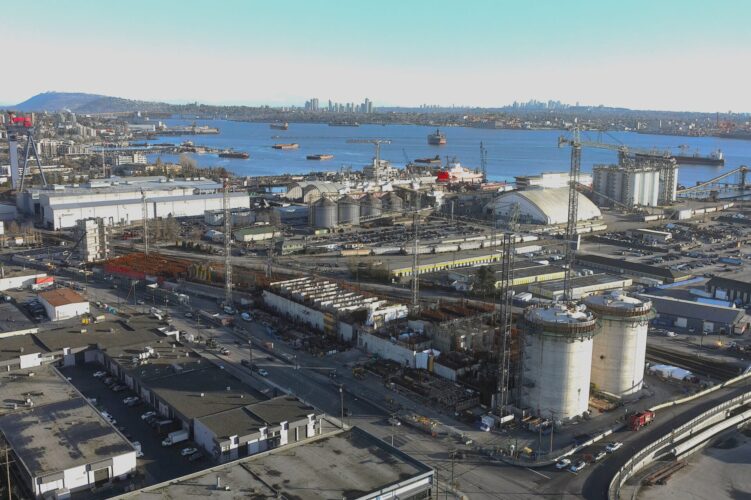
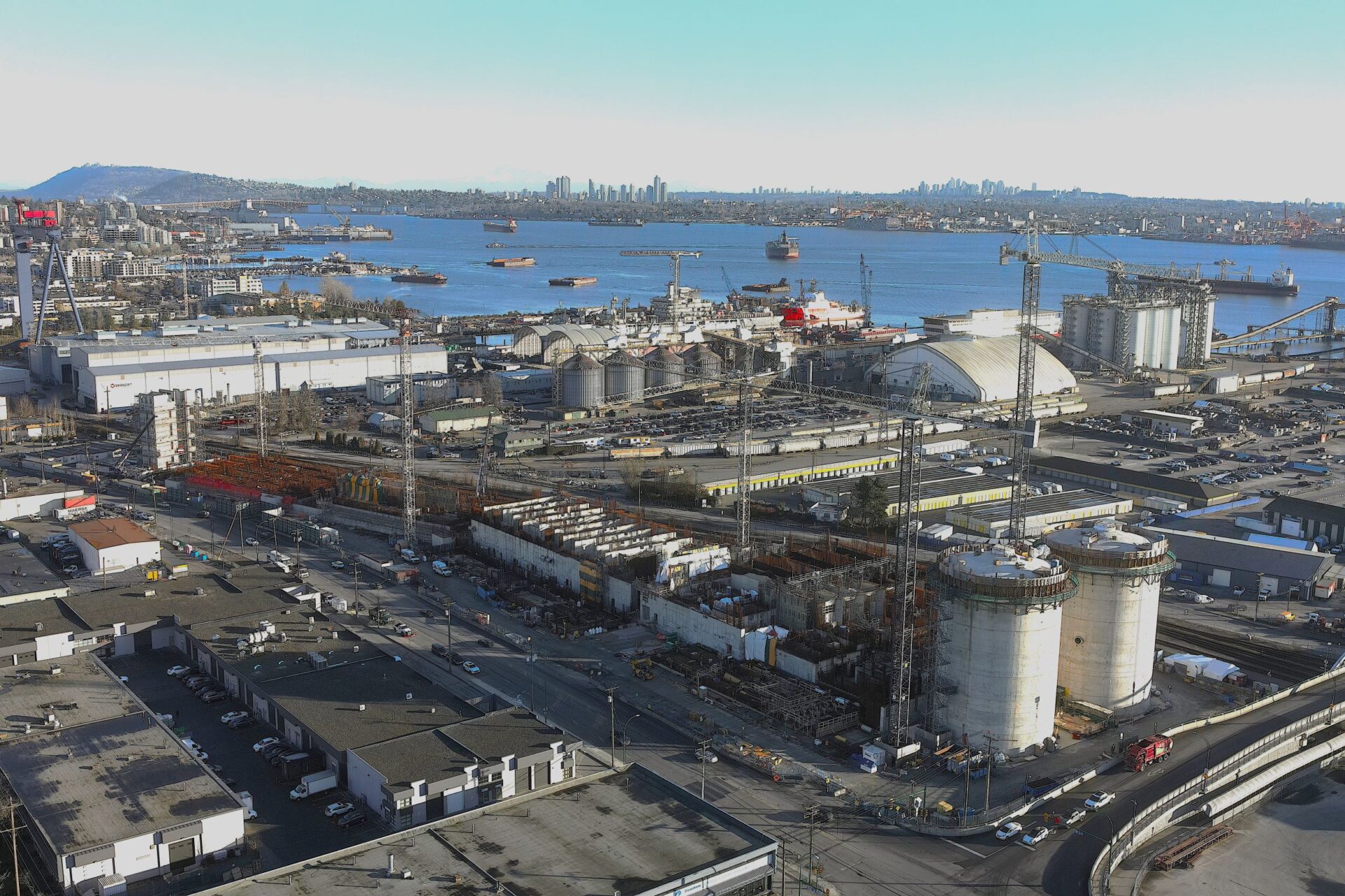
3. Scaling for the Coast: North Shore Wastewater Treatment Plant Program (BC)
Upgrading aging facilities while adapting to modern federal environmental mandates under tight spatial constraints is a challenge all utility managers recognize. Led by Metro Vancouver, the $3.86 billion North Shore Wastewater Treatment Plant program represents one of the coast’s most ambitious environmental overhauls.
The new plant replaces the 1961 Lions Gate facility—one of the last primary-treatment-only facilities on the West Coast—upgrading the region to tertiary filtration, the highest level of municipal wastewater treatment. Squeezed onto a compact 4.5-hectare urban site, general contractor PCL Construction and engineering lead AECOM are bringing the complex plant through to completion. It is designed to serve over 300,000 residents and businesses across North and West Vancouver, as well as the Squamish and Tsleil-Waututh Nations.
Beyond the plant’s structural build, the program required extensive conveyance work—delivered by North Shore Conveyance Partners (a joint venture of Kenaidan Contracting and Michels Canada)—installing miles of new trunk sewer lines and a high-capacity pump station across active port lands and rail corridors. Built to Envision Gold standards with sea-level rise and seismic resilience in mind, the enclosed facility features advanced odour-control systems and resource-recovery technology to capture waste heat for nearby communities.
Engineering Beyond the Blueprint
Whether it is navigating 110-meter deep shafts, managing high-pressure subterranean slurry, or routing multi-metre steel mains through congested urban corridors, these mega-projects prove that modern water management is as much about logistics and technical bravery as it is about hydraulics.
Want to dive into the specs, contractors, and project timelines behind all 50 of Canada’s largest water projects? Explore the full breakdown in our interactive e-magazine.