Why Today’s Testing Framework Falls Short – and What Must Change to Prevent Outbreaks.
Legionella outbreaks are a growing global concern, with recent cases reported across multiple continents, including in North America, Italy, Australia, and Poland, all of which led to fatalities. Even cruise ships have not been spared, with 12 cases reported between November 2022 and June 2024. Legionella is not confined to a single region or climate; Legionella outbreaks are a worldwide challenge that are increasing in frequency and severity, underscoring the urgent need for global vigilance and improved prevention and detection strategies.
Understanding the Threat: Why Legionella Matters
Legionella pneumophila, particularly serogroup 1 (SG1), is one of the bacterium responsible for Legionnaires’ disease, a severe form of pneumonia with a mortality rate between 5% and 15%. The pathogen thrives in human-made water systems such as cooling towers, plumbing networks, and hot tubs, making its detection and control imperative to ensuring public safety. Rapid urban growth in recent years has led to more complex and aging water systems, increasing the risk of biofilm formation and microbial contamination, while the bacterium’s ability to resist standard disinfection methods means that even well-maintained systems can harbor hidden risks.
Business Impact: Why companies should care
In addition to the health implications, Legionella outbreaks can seriously damage reputations and operations; hotels, hospitals, and industrial facilities face shutdowns, lawsuits, and regulatory penalties. The economic burden of such incidents can also be significant, including remediation costs, operational downtime, legal liability, and potential civil lawsuits.
Even if the ISO (International Organization for Standardization) 11731:2017, reference standard for assessing the presence of Legionella is adhered to, legal protection is not guaranteed. In cases where a company failed to take reasonable precautions, it could be argued that the outbreak was foreseeable and preventable, leading to potential criminal charges in cases of gross negligence or death.
Regulatory Landscape
The regulatory landscape for Legionella testing varies globally but shares a common goal: to prevent outbreaks from contaminated water systems. In the U.S., agencies like the Occupational Safety and Health Administration (OSHA) and the Environmental Protection Agency (EPA) require water safety programs and testing, especially in healthcare and industrial settings. Although there is significant variation between states, with some such as New York mandating registration and testing for cooling towers. European countries follow the European Centre for Disease Prevention and Control (ECDC) guidelines, with national laws mandating testing in high-risk environments, and some countries such as France and Germany requiring routine Legionella checks in residential and public buildings.
ISO 11731:2017 specifies the use of culture methods for the isolation of Legionella and the estimation of their numbers in water samples. Though culture remains the legal benchmark in many regions, rapid PCR testing methods are gaining traction – culture alone is not capable of proactive surveillance and early detection. One of the reasons for this is that not all Legionella species are culturable, thus the methods described in ISO 11731:2017 are not able to recover all species of Legionella and has implications for reliable testing. Among other reasons discussed below, this has resulted in a global shift toward proactive risk management and adoption of advanced detection technologies with standardized methodologies.
In Canada, the Public Services and Procurement Canada (PSPC) developed the standard MD-15161 Control of Legionella in Mechanical Systems, which provides requirements for the proper design, installation, maintenance, operation and bacterial testing to control the growth of Legionella bacteria. The standard also requires the development of a site-specific Legionella Bacteria Control Management Program (LBCMP). In this case, qPCR is authorized after cleaning or disinfection and in emergency mode.
What Makes Legionella Detection So Complex?
The biggest challenge in Legionella detection is viability—distinguishing live, infectious bacteria from dead ones. In addition, traditional culture methods (ISO 11731:2017) are slow, taking more than 7 days, and can miss viable but non-culturable (VBNC) cells, which are potentially pathogenic. This leads to the underreporting of contamination and delayed remediation.
In the food safety testing industry, the enormous value of rapid molecular methods for pathogen detection was recognized decades ago, driven by the need for faster decision-making, improved risk management, and regulatory confidence. Until recently however, the water testing industry has remained reliant on traditional detection techniques, despite the demand for more advanced technologies.
To meet expectations from end-users and governments faced with Legionella risk, ISO developed a new standard. First published in 2012, ISO/TS 12869 is a recognized international standard that defines a validated qPCR method for detecting Legionella in water, ensuring consistency and reliability across laboratories. By specifying methodological performance evaluation and quality control requirements, the standard improves testing by enabling faster, more sensitive detection compared to traditional culture methods, making it ideal for timely public health interventions. However, under certain circumstances, there is a risk of overestimating presence of Legionella by detecting DNA from dead cells. Innovative reagents have been developed to overcome this challenge, ensuring that only live Legionella are quantified, aligning molecular results more closely with health risk models.
qPCR for Accurate Detection, Quantification, and Identification of Legionella
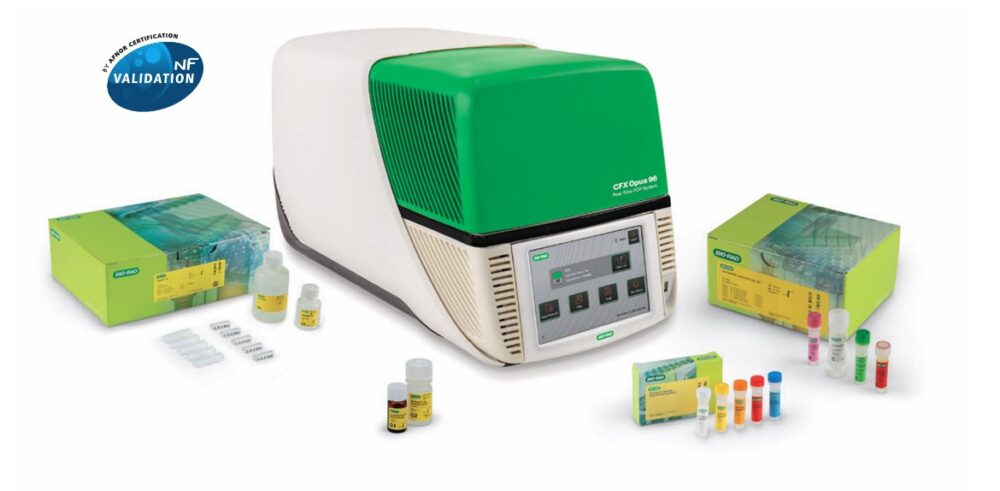
Bio-Rad’s iQ-Check Legionella solution offers a rapid (<4 hours), reliable, and user-friendly platform for the detection and quantification of viable Legionella in water samples. Used in conjunction with Bio-Rad’s Free DNA Removal Solution which removes DNA from dead cells before PCR, laboratories can significantly minimize false positives and ensure that only live and infectious cells are quantified by PCR. This not only accelerates the decision-making process for water safety management but also aligns testing results more closely with actual health risks, supporting both regulatory compliance and improved public health outcomes.
First validated in 2007, AFNOR certification was renewed in 2025, providing a critical layer of assurance in analytical reliability. This endorsement confirms that the method meets stringent performance criteria following the ISO/TS 12869 requirement, ensuring reproducibility, accuracy, and robustness across diverse laboratory settings. The added value lies in the credibility and trust it brings to public health stakeholders, enabling confident decision-making in the prevention and control of Legionella-related risks.
The kits can also be used in conjunction with Bio-Rad’s XP-Design Assay L. pneumophila SG1 test. Following a positive result from the iQ-Check kit confirming the presence of Legionella bacteria, the XP-Design Assay offers high sensitivity and specificity for SG1 to confirm its presence within an hour. This allows labs to easily screen out negative samples and submit positive samples to further processing.
Current Practices: A Call for Change
Legionella testing is generally a part of water management programs but is not universally mandated. Many regulations only provide guidance for risk management, and implementation varies by jurisdiction, facility type, and owner commitment. While culture is the gold standard, it is crucial that the water testing industry shifts towards molecular testing methods.
In addition to conducting periodic testing using validated methods, industries and facility managers should also adopt prevention strategies to mitigate the risk of Legionella outbreaks:
- Water management programs: Implement comprehensive plans that include risk assessments, control measures, and routine monitoring for all facilities.
- Staff training: Ensure that personnel are trained in Legionella detection, outbreak prevention, and response protocols.
- Protocols for documentation and reporting: Maintain detailed records of testing, maintenance, and corrective actions to demonstrate compliance and support investigations.
- Proactive testing: Establish trends with proactive testing rather than reactive approaches.
- Robust regulatory guidelines: Clear guidelines on thresholds and broader routine surveillance to prevent outbreaks
Legionella analysis is not just a regulatory checkbox—it’s a strategic necessity. With the rise of viability qPCR, smart monitoring, and evolving standards, we now have the tools to detect, quantify, and act faster than ever before. But technology alone isn’t enough. Education, collaboration, and a commitment to public health must drive efforts to reduce outbreaks.

Virginie Forestier, Global Product Manager, Bio-Rad Laboratories, France