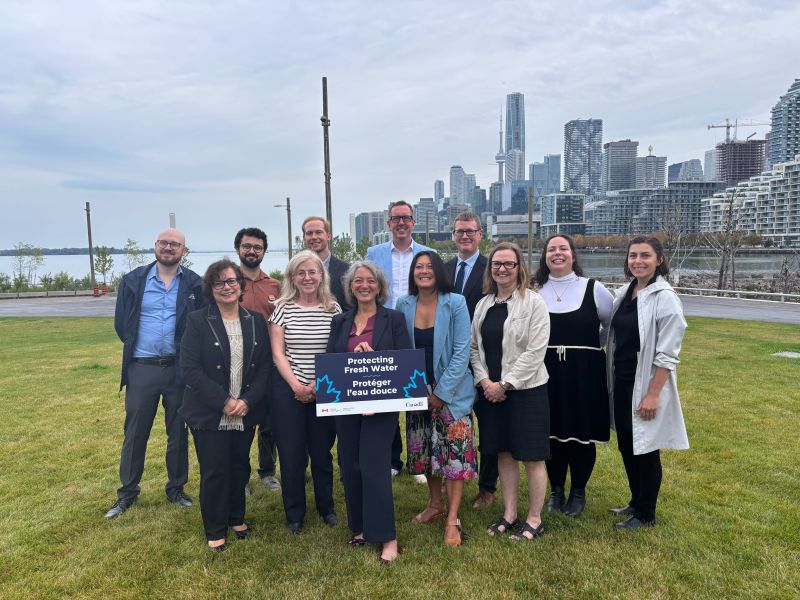
The Government of Canada announced the launch of public engagement to develop Canada’s first National Water Security Strategy.
The Strategy will help secure Canada’s freshwater future by addressing freshwater challenges and seizing opportunities to protect ecosystems, strengthen the resilience of communities, and keep industries water secure and thriving. Canadians are invited to share their views through an online platform on the Canada Water Agency’s website. The survey is open from September 9 to October 25, 2026, and a summary of what is heard will be shared later this year.
Julie Dabrusin, Minister of the Environment, Climate Change and Nature and Minister responsible for the Canada Water Agency (CWA) also announced an investment of $6.6 million in 31 partner-led projects to target the most significant environmental challenges affecting water quality and ecosystem health in the Great Lakes. This is in addition to nearly $6.5 million over four years, starting in 2024-2025, in dedicated funding to the Chiefs of Ontario and Anishinabek Nation to support First Nations’ participation in Great Lakes governance, science, and stewardship.
“Fresh water is central to our quality of life, our environment, and our economic security. Developing a National Water Security Strategy will bring Canadians together around a shared vision for a water-secure Canada, informed by Indigenous Knowledge Systems and diverse experiences. Through investments in the Great Lakes, we are turning that vision into action to protect water quality and ecosystems for generations to come,” said Dabrusin.
These investments are part of the $420 million over 10 years (starting in 2023) dedicated to accelerating the restoration and protection of the Great Lakes, through the Great Lakes Freshwater Ecosystem Initiative – a part of Canada’s larger investment of $650 million in the Freshwater Action Plan.
These projects are funded through the Great Lakes Freshwater Ecosystem Initiative, which aims to address key priorities, including restoring water quality and ecosystem health in Great Lakes Areas of Concern; preventing toxic and nuisance algae; reducing releases of harmful chemicals; and increasing participation of Indigenous Peoples in freshwater governance, stewardship, and monitoring.
Among the recipients:
Toronto and Region Conservation Authority is receiving $320,000 over two years to complete the assessment of beach closures, algae, fish consumption restrictions, and habitat loss. This project supports Aquatic Habitat Toronto in evaluating waterfront infrastructure designs and tracking local restoration success.
Batchewana First Nation is receiving $1.75 million over three years to restore fish habitat and ecosystem function at Whitefish Island in Sault Ste. Marie, and to support the nation’s role in decision-making and the sharing of Traditional Ecological Knowledge in the St. Marys River Area of Concern.
Royal Botanical Gardens is receiving $250,000 over one year to restore and protect wetland habitat in Cootes Paradise and Grindstone marshes within Hamilton Harbour. This project will also support activities such as operating a fishway barrier to improve water clarity, restoring shoreline and channels, and reintroducing southern wild rice in collaboration with the Mississaugas of the Credit First Nation.
“Canadians care deeply about water and are concerned about how it is managed, yet feel overwhelmingly uninformed about it. The National Water Security Strategy is our chance to change that: to start a national conversation, turn it into action, and galvanize Canadians behind a more water-secure future,”said AquaAction president Soula Chronopoulosm, who was in attendance at the launch event, held in Toronto.
Featured image: (Government of Canada)