By Kalpna Solanki CWP CPHI(C) BSc MBA
10-Second Read
-
Next-Gen Tech Pitch: Water Canada Editorial Advisory Board member Kalpna Solanki (GAMECHANGERS Inc. / former WEF Board Trustee) highlights high-tech water careers spanning robotics, AI, and cybersecurity.
-
Reframing Essential Services: The message connects everyday routines—turning on the tap or flushing the toilet—directly to public trust and modern technology.
-
WEFTEC Focus: Water industry leaders gather to engage the future workforce and tackle critical sector questions.
WEFTEC calls itself “Where the Water Community Connects,” and after a week in New Orleans, I can say the tagline is accurate. The Water Environment Federation’s (WEF) annual technical exhibition and conference ran September 26 to 30, 2026, and brought together close to 24,000 water professionals from more than 70 countries, along with over 1,000 exhibitors. For me, though, the connections started well before the exhibit hall opened.
Before the doors opened
My WEF Board of Trustees work began on September 24 with board meetings, planning sessions, and conversations about where the federation goes next. It was also my last board meeting, as my term as a trustee was ending. I am grateful to the people I served with.
One of those decisions was announced to the membership during the week: a $1 million Federation Impact Grant program for WEF Member Associations. The funding comes from the sale of WEF’s former headquarters building in Virginia that Member Associations helped finance 40 years ago, so it is going back to the community that built it.
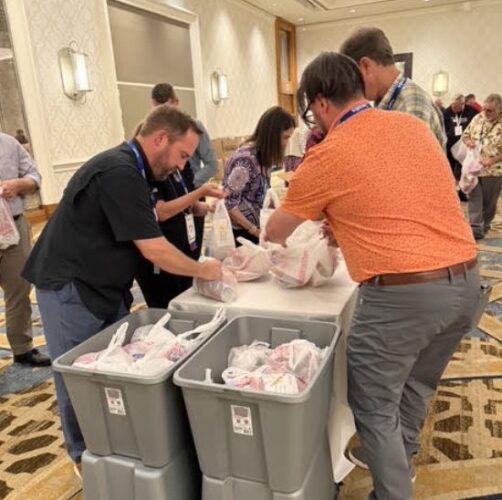
We also gave back to the host city. Volunteers worked with Blessings in a Backpack to put together bags of weekend meals for school-aged children who face food insecurity, and each bag included a note of encouragement. Later I helped pack hygiene kits, and WEF volunteers also supported New Orleans through Waterpalooza and the WEF Community Service Project.
A 30-second pitch for the next generation
At WEF’s House of Delegates meeting, my table took on a question every Canadian utility should be asking: how would you explain a career in water to a high school student in 30 seconds?
With a little help from artificial intelligence, we wrote a pitch in the way teenagers actually talk:
“Real talk: every time you hit the tap, flush the toilet, or grab a glass of water, you’re trusting someone to not mess it up. Lowkey, that someone could be you. And no, it’s not boring pipes and hard hats. You get to work with seriously cool tech like robots, automation, AI, and cybersecurity… There’s a lane for everybody… No cap, it all starts with water.”
It made people laugh, but the point is serious: we won’t recruit the next generation unless we tell our story in words that make sense to them. WEFTEC’s new Workforce Hub, with live demos, hands-on learning and career pathways, was a good start.
Bigger Questions, Better Questions
The opening sessions made the case for curiosity. Mina Guli had just finished a 2,000-mile run down the length of the Colorado River, and she asked a question I’m still thinking about: “Are we moving fast enough toward a circular water economy?” With the Mississippi River flowing right outside my hotel and the convention centre, it was hard to ignore. The same question applies to the Fraser, the St. Lawrence and every watershed in Canada.
Keynote speaker Diana Kander built on that idea. She argued that the best opportunities start with better questions, and that our expertise can become a blind spot once we stop asking them.
On the show floor
The exhibition reflected the sector’s priorities:
- Circular Water Economy Pavilion: real-world examples of Reduce, Reuse, Regenerate, from potable reuse to nutrient and energy recovery.
- Water-AI Nexus Center of Excellence: now in its second year, with more than 20 sessions on both AI for water and water for AI.
- International Pavilion and Global Hub: 7 country and regional pavilions and 54 companies in one space for the first time.
- New Utility Pavilion: a space for utilities to learn from each other on shared challenges.
- Innovation Pavilion: where start-ups meet the people who can help them scale.
- Workforce Hub: this immersive exhibition floor space is dedicated to water operations personnel, career development, and the annual Operations Challenge.
The program had more than 135 technical sessions, all reviewed and curated by more than 200 volunteers.
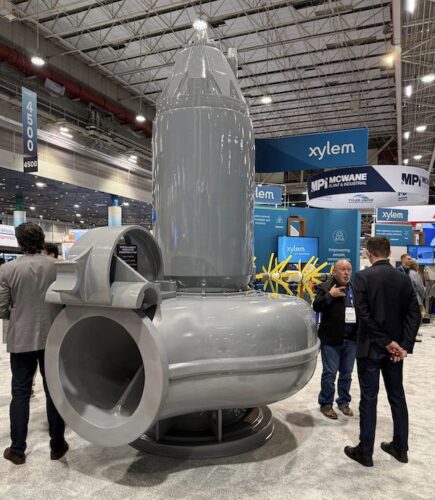
One exhibit stopped people in their tracks. Xylem displayed what its placard called the “World’s Largest Production Submersible Pump,” the Flygt C-3800, with a 32-inch discharge and a listed capacity of 3,000 litres per second (50,000 US gallons per minute).
Sewer intelligence
Artificial intelligence was everywhere this year, and some of it had four legs. I met Hydro, a robot dog of about 30 kilograms from Virginia’s Hampton Roads Sanitation District (HRSD), deployed under HRSD’s Digital Water Infrastructure (DWI) program. HRSD also took part in the session “From Digital Twins to AI Agents: What Utilities Are Implementing Now.”
The conversation has clearly changed from “should we?” to “how do we do this responsibly?” The timing was memorable, too. During the conference, media outlets reported that the U.S. administration had ordered federal agencies to replace the term “Artificial Intelligence” with “Super Intelligence,” or “SI.” Our industry has arguably had its own SI all along: Sewer Intelligence.
Three companies doing SI work caught my attention. Eaos offers an agent called Eddy that maps an entire facility and simulates changes before they go live. Delta Bravo AI’s aquaspec uses permit-aware agents to cut reporting work from weeks to hours. NJBSoft’s SAMS platform combines compliance, asset management, and a new Lead and Copper Rule Improvements (LCRI) module on one GIS platform.
Team Canada takes gold
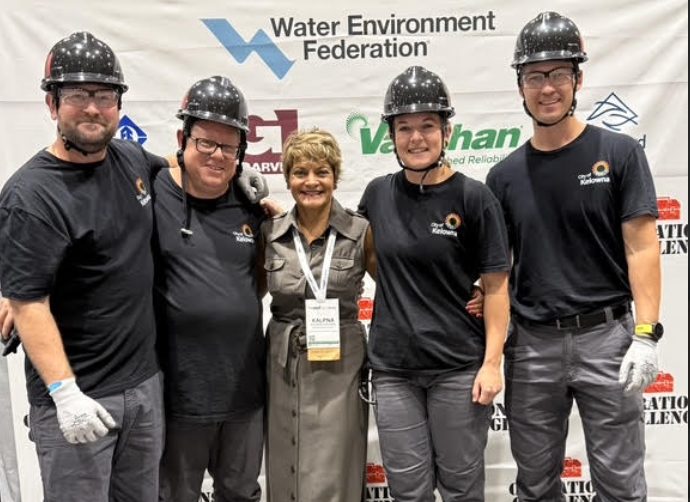
For Canadian readers, the highlight of the week was the Operations Challenge, the “Sewage Super Bowl,” now in its 39th year. Dung Deal, a City of Kelowna team, won first place in the Global Division. It was Kelowna’s first-ever Operations Challenge team and the only team from Canada. It was also the only co-ed team with a woman doing pipe-cutting, one of the competition’s most physically demanding tasks.
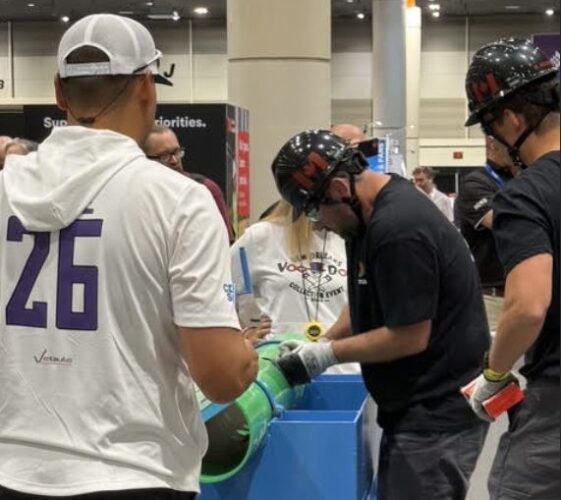
Congratulations to Dennis, Jason, Amanda, and Paul. You showed the world what Canadian Operators can do.
The people
The numbers are big, but the people are what stay with you: old friends in the hallways, new ones at every booth. Jammin’4Water officially joined the WEF family and raised $60,000 for water charities, and fellow trustee Walid Khoury woke everyone up with a DJ set at the Opening General Session.
Next year, WEF celebrates its centennial at WEFTEC 2027 in Chicago. Bring a Canadian team, bring your questions, and stay curious.
Kalpna Solanki, is with GAMECHANGERS Inc. in North Vancouver, BC, and has just completed her term on the Water Environment Federation Board of Trustees – her 13th board!