While political posturing over Lake Ontario holds no legal weight in Canada, experts warn that escalating trade tensions could spill over into binational water management.
The escalating trade dispute between the United States and Canada has crossed into Great Lakes geography. Following contentious tariff negotiations, U.S. President Donald Trump posted on social media that the U.S. is considering renaming Lake Ontario to “Lake America,” citing diminishing business expectations with the province of Ontario.
While the statement generated immediate headlines, water sector professionals, conservation authorities, and policy experts are looking past the rhetoric to evaluate what this signals for cross-border water governance.
Can a U.S. President actually rename Lake Ontario?
In short: Not unilaterally across the border.
Under U.S. administrative law, a president can order federal agencies—such as the U.S. Board on Geographic Names (USBGN)—to adopt new naming conventions for official domestic maps and federal documents, similar to previous presidential actions regarding domestic land features or coastal zones.
However, Lake Ontario is an international boundary water body shared between two sovereign nations.
- No Canadian Jurisdiction: A U.S. directive has zero legal effect on Natural Resources Canada, the Province of Ontario, or Canadian municipalities.
- International Standards: Global navigation, nautical charting, and cartographic standard-setters (such as the International Hydrographic Organization) rely on bi-national agreement for border-straddling features.
“Ontario” itself originates from the Huron word Ontari’io, meaning “great lake,” a name embedded in centuries of legal treaties, international maritime law, and international cartography.
The real threat: Fracturing binational water governance
While the name change is legally non-binding in Canada, water sector stakeholders are closely monitoring the political climate for secondary impacts on environmental policy.
The Great Lakes Basin supports 40 million people and relies on unprecedented levels of bilateral cooperation:
- The International Joint Commission (IJC): Established under the Boundary Waters Treaty of 1909, the IJC prevents and resolves disputes over shared waters. A breakdown in diplomatic goodwill makes resolving complex water-level management disputes (such as Plan 2014 regulating Lake Ontario outflows) significantly harder.
- Great Lakes Water Quality Agreement (GLWQA): First signed in 1972 and updated in 2012, the GLWQA coordinates binational research and remediation efforts targeting Areas of Concern (AOCs), toxic pollutants, harmful algal blooms, and invasive species.
- Shared Infrastructure & Utilities: Municipal drinking water and wastewater providers on both sides of the lake rely on shared scientific datasets for climate resiliency, stormwater modeling, and source water protection.
If geopolitical friction disrupts diplomatic channels, joint research initiatives and shared funding pipelines—such as cross-border invasive species monitoring or nutrient runoff mitigation—could face delays or political gridlock.
Sector reaction
Canadian officials and sector representatives have urged calm, keeping the focus on operational realities. Ontario Premier Doug Ford dismissed the naming proposal as “rhetoric,” highlighting the deeply integrated supply chains, energy grids, and water systems shared between Ontario and border states like New York.
For Canadian water utilities and conservation authorities operating in the Lake Ontario basin, day-to-day operations remain unchanged. Intake monitoring, wastewater treatment, stormwater infrastructure upgrades, and local watershed management continue under existing provincial and federal frameworks.
The Bottom Line
Lake Ontario isn’t changing its name on Canadian maps anytime soon. However, the story serves as a stark reminder that Great Lakes water management does not exist in a vacuum—and maintaining strong, collaborative relationships with U.S. counterparts remains essential for protecting shared freshwater resources.
Referenced media coverage and sources
- Hindustan Times: Trump suggests renaming Lake Ontario as ‘Lake America’ amid US-Canada trade war
- LiveMint: Trump wants to rename Lake Ontario ‘Lake America’: Where is it, and can the US president legally do it?
- Washington Examiner: Trump floats changing name of Lake Ontario to Lake America
- Times of India: ‘Lake America’: Trump floats plan to rename Lake Ontario amid escalating US-Canada trade row
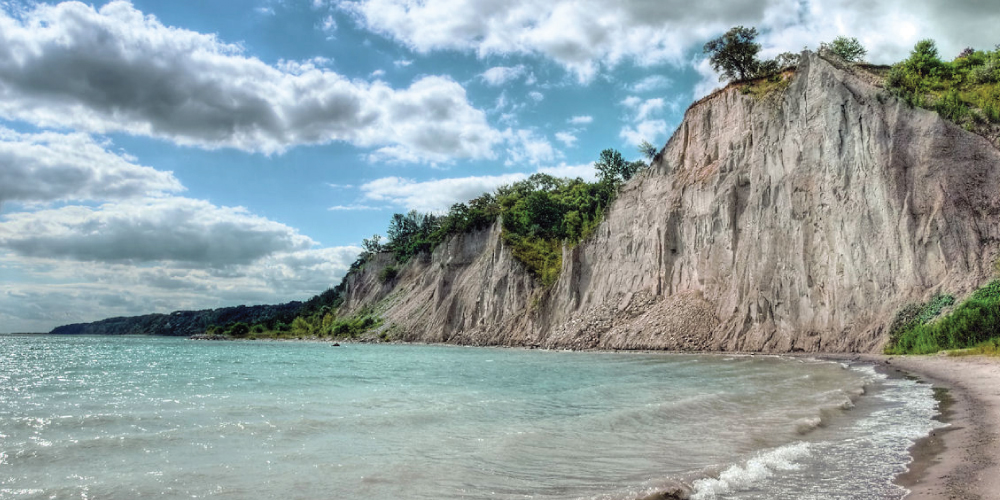
Featured image: Scarborough Bluffs Park on Lake Ontario. (Great Lakes Commission)