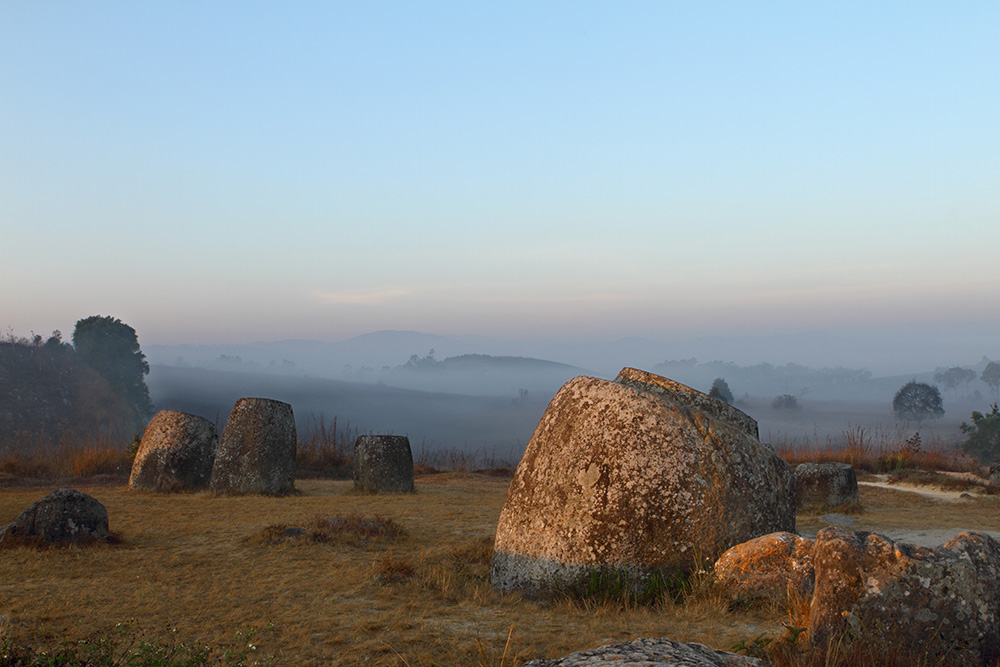
Researchers at McGill University have used 2,000-year-old stone jars located in Laos to observe long-term ecological processes including how strongly tree cover affects small freshwater ecosystems.
The study showed that due to decomposing leaf litter, jars located beneath trees accumulated more nutrients and are dominated by oxygen-consuming organisms, a McGill University release said. Jars in open areas, by contrast, contained fewer nutrients and more oxygen-producing organisms such as algae.
The stone jars were carved from bedrock and placed in the Plain of Jars by an unknown people and collected rainwater, subsequently forming small aquatic habitats.
Because they have remained in place since the Iron Age (1200 BC to 500 BC), the release said, they allow scientists to observe long-term ecological processes that are rarely captured in modern experiments.
“We use experiments to simplify the complexity of ecological systems, but they can only run for a feasible time span,” Lars Lønsmann Iversen, Assistant Professor of Biology at McGill and study co-author said. “These stone jars have been standing in nature for 2,000 years, collecting water, and all the biology within these small aquatic habitats has been operating for that period. Suddenly, we’re able to look at effects over very long timescales.”
The researchers sampled 39 jars across five sites, working with local scientists, heritage experts and community members.
They sampled the jars twice, the release said: once during the dry season and once during the wet season, and measured water chemistry, oxygen levels, nutrient availability and litter deposition to understand the ecological conditions within each self-contained habitat.
Laura Käse, lead author of the paper and a Postdoctoral Fellow at the University of Copenhagen, noted that even small differences in surrounding trees can change water chemistry.
“This helps us see how forests and small water bodies are connected over time,” Käse said.
The full report was published in Ecography and can be read here.