By Monica Seidel and Claire Foran
As we enter the snowy season, many ecosystems seem to freeze in time, but nature is always hard at work. Ontario wetlands are no exception. Through winter, they continue to store carbon, provide habitat for wildlife, and quietly prepare for their busiest season: spring migration.
As the ice begins to thaw, millions of migratory ducks start their return to Canada through Ontario, traveling along the Atlantic and Mississippi flyways. During this season, the wetlands are shallow and the ice melts fast, creating an influx of diverse new life, from invertebrates to vegetation. For mallards, wood ducks, and other migrants, these wetlands offer exactly what they need: a place to refuel, feed, form breeding pairs, and prepare for nesting. Fortunately for these birds, landowners in Central-Eastern Ontario took action in 2025 to ensure more wetland stopovers were available ahead of their spring 2026 migration.
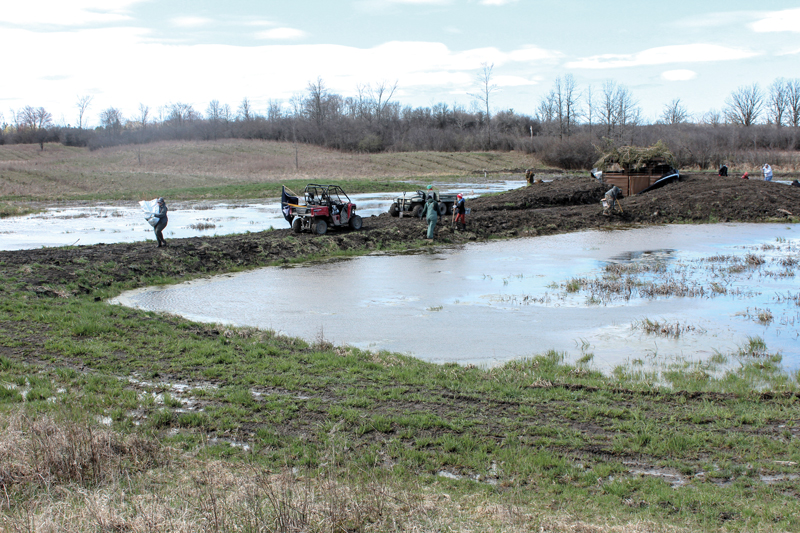
Over the summer and fall, 15 new wetlands were created thanks to a partnership between Ducks Unlimited Canada (DUC) and Watersheds Canada. To start, DUC connected with local landowners to identify potential wetland restoration sites. Once the project design was complete, the ground was dug, and water was brought back to the landscape. Watersheds Canada teams then delivered their flagship program, The Natural Edge, and further enhanced the ecological benefits of each site by collaborating with the landowners to design custom shoreline renaturalization plans. In total, 13,500 native plant species including dogwoods, elderberry, meadowsweet, birches, cranberries, and tamaracks were added to the shores of the constructed wetlands.
Other landowners further west in the Crowe Valley watershed also took action by restoring their water’s edge with native plants through a new partnership between Watersheds Canada and Crowe Valley Conservation Authority. All of these different restoration projects were made possible because of financial support from Wildlife Habitat Canada’s Canadian Wildlife Habitat Conservation Stamp Program, the Resilient Agricultural Landscape Program (RALP) – Marginal Lands Initiative, the Great Lakes Local Action Fund, and the Canada Water Agency through the Government of Canada’s EcoAction Community Funding Program.
The native plantings that now surround the edges of the wetlands form protective buffers that waterfowl rely on for safe nesting during the spring. These quiet, vegetated margins offer cover from predators, space to feed and rest, and corridors connecting duck pairs to the larger wetlands they move to as the season progresses. Later in the year, as summer passes and the leaves start to change, waterfowl will once again flock to small wetlands like these to prepare for their journey south, continuing a migration cycle that has shaped this landscape for generations.
Wetlands are power players on the working landscape. Small wetlands, in particular, punch far above their weight by capturing nutrients and slowing water movement across the land. These restored sites will also provide essential services for local communities, including improved water quality that flows through watersheds into the Great Lakes, reduced flood risk, and greater climate resiliency. What is good for the ducks is good for all of us.
Despite these benefits, wetland loss in Ontario continues to threaten biodiversity and the many benefits wetlands provide. According to a federal report, up to 98 per cent of wetlands in densely populated areas across Canada have been lost, showing the value of solutions-oriented projects like those being led by Watersheds Canada, DUC, and landowners. These projects demonstrate the importance of locally-led action, community partnership, and cross-sector collaboration. Each involved stakeholder brings their own experience, knowledge, passion, and motivation to make a positive impact for communities and wildlife for years to come.
This World Wetlands Day, Feb. 2, take inspiration from these dedicated landowners and think about how you can take positive action in your community. To get started, brave the cold and head outside! Learn about and visit your local wetlands and the waterfowl who have made Canada their home, too. If you have a shoreline or agricultural property that could benefit from planting native species or could be eligible for a wetland restoration, contact Watersheds Canada or Ducks Unlimited Canada to learn about their landowner programs. We can all work together to create, enhance, and protect Canada’s wetlands.
Watersheds Canada and Ducks Unlimited Canada (DUC) are two leading national conservation action charities. For more than 87 years, DUC has partnered with rural landowners and farmers across Ontario to bring water back to the land. From project design to working directly with local contractors, DUC’s conservation specialists help guide each step of a wetland restoration. Watersheds Canada is committed to providing restoration and education programs across the country to enhance and protect the health of lakes, rivers, wetlands, and shorelines. Locally supported projects bring together landowners, Indigenous communities, municipalities, children, youth, and community groups for lasting freshwater conservation.
Monica Seidel is a communications and fundraising manager at Watersheds Canada.
Claire Foran is a communications specialist at Ducks Unlimited Canada.
[This article appeared in the January/February 2026 issue of Water Canada.]
Featured image: Thanks to a partnership between Ducks Unlimited Canada and Watersheds Canada, 15 new wetlands were created. (Watersheds Canada)